AI’s 2026 Impact: Job Automation vs. Creation in the US

The Rise of AI in 2026: Automating 1 Million US Jobs While Creating 1.5 Million New Ones
The dawn of the 21st century brought with it the promise of technological advancement, and few technologies have captured the human imagination—and apprehension—quite like Artificial Intelligence (AI). As we stand on the cusp of 2026, the discussion around AI’s impact on the global, and specifically the US, job market has intensified. Projections suggest a fascinating, albeit complex, scenario: approximately 1 million existing US jobs could be automated, yet concurrently, 1.5 million new jobs are expected to be created. This isn’t merely a statistical dance; it’s a profound societal and economic transformation that demands our attention and strategic foresight. Understanding this intricate balance of AI job impact, job displacement, and novel opportunities is crucial for individuals, businesses, and policymakers alike.
The narrative surrounding AI often swings between utopian visions of enhanced productivity and dystopian fears of widespread unemployment. The reality, as always, lies somewhere in the middle, characterized by significant shifts rather than outright destruction or universal prosperity. This article aims to dissect the anticipated AI job impact by 2026, providing a comprehensive analysis of the sectors most affected, the nature of the newly created roles, and the broader financial and societal implications for the United States. We will explore the mechanisms of automation, the skills gap it creates, and the imperative for proactive adaptation through education and policy. The future of work is not just about technology; it’s about how humanity chooses to interact with, adapt to, and harness that technology.
Understanding the Automation Wave: The 1 Million Jobs at Risk
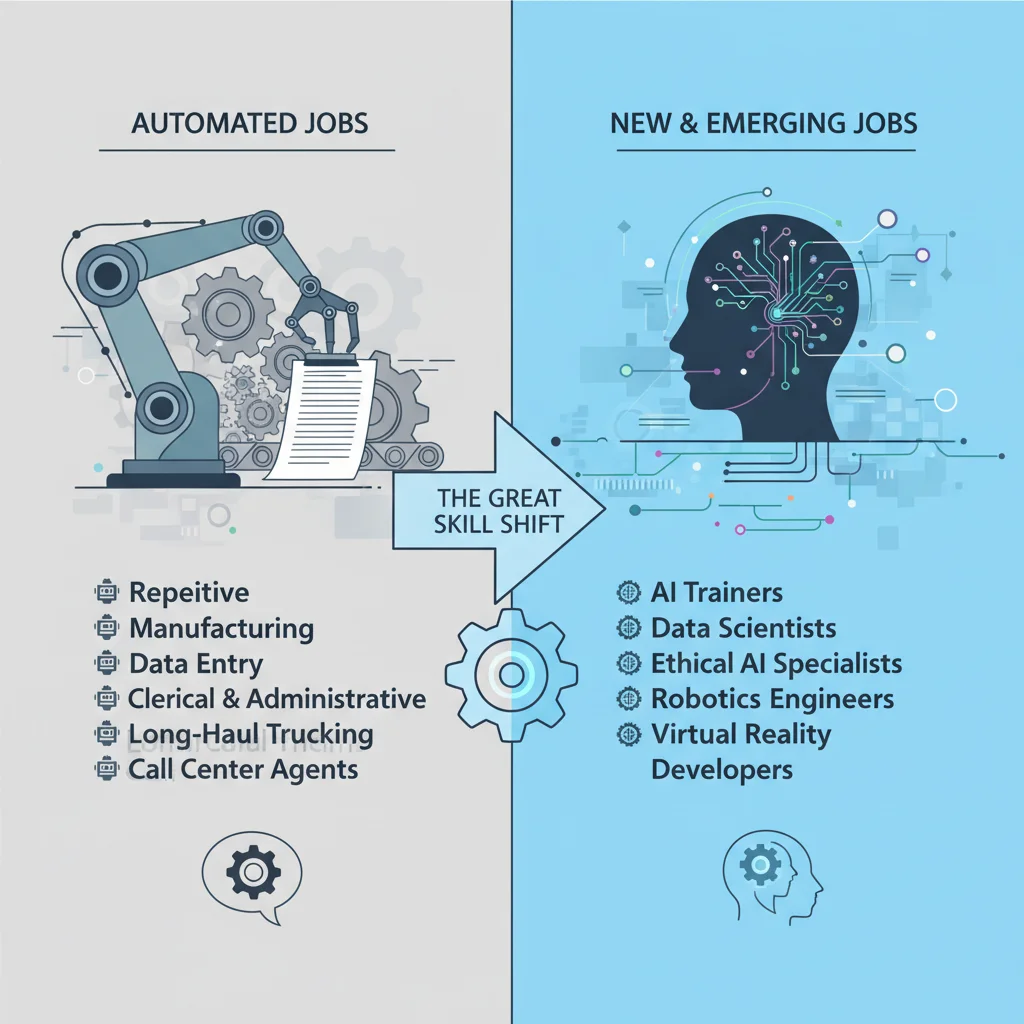
When we talk about 1 million US jobs being automated by 2026, it’s essential to understand what kinds of jobs are most susceptible and why. Automation, driven by advancements in AI and robotics, primarily targets tasks that are repetitive, predictable, and rule-based. These are often roles that involve data entry, routine administrative tasks, manufacturing assembly lines, customer service inquiries (through chatbots), and even some aspects of logistics and transportation.
Historically, technological revolutions have always led to job displacement. The agricultural revolution shifted labor from farming to factories, and the industrial revolution moved workers from manual labor to more specialized manufacturing roles. AI represents the next wave, but its impact is arguably broader and faster due to its ability to mimic human cognitive functions, albeit in a narrow scope. The AI job impact will be felt most acutely in sectors characterized by high volumes of standardized processes.
Consider the manufacturing sector, where robotic process automation (RPA) can perform assembly, quality control, and packaging tasks with greater speed and precision than humans. In the administrative field, AI-powered software can handle scheduling, email management, and document processing, freeing up human staff for more complex problem-solving or interpersonal roles. The retail sector is another area ripe for automation, with self-checkout kiosks, inventory management systems, and automated warehousing already commonplace. Even in the financial services industry, algorithms are increasingly handling data analysis, fraud detection, and basic financial advising.
It’s crucial to distinguish between job automation and task automation. While a full job might not disappear, many of its constituent tasks can be automated, leading to a significant alteration of the role. This often means that the human worker’s responsibilities shift towards oversight, maintenance, and interaction with the AI systems, demanding a different skill set. The 1 million jobs projected to be automated are those where a substantial majority of tasks can be efficiently taken over by AI, making the human role redundant or significantly diminished in its current form.
The economic implications of this displacement are multifaceted. On one hand, automation can lead to increased efficiency, reduced operational costs, and higher productivity for businesses, potentially driving economic growth. On the other hand, it poses significant challenges for the displaced workforce, including potential unemployment, underemployment, and the need for extensive retraining. This is where the societal aspect of the AI job impact becomes paramount, requiring robust social safety nets and proactive governmental policies to mitigate adverse effects.
The Emergence of New Opportunities: 1.5 Million New Jobs Created
While the automation of 1 million jobs presents challenges, the projection of 1.5 million newly created jobs offers a silver lining and highlights the transformative, rather than purely destructive, nature of AI. These new roles are not merely replacements; they are entirely new categories of employment that arise directly from the development, deployment, maintenance, and ethical oversight of AI systems. This positive AI job impact signifies a net gain in employment, albeit with a significant shift in required skills.
The creation of these jobs can be broadly categorized into several areas:
- AI Development and Engineering: This includes roles such as AI researchers, machine learning engineers, data scientists, AI developers, and robotics engineers. These professionals are at the forefront of designing, building, and refining the AI algorithms and systems that power automation. Their expertise in programming, data modeling, algorithm optimization, and deep learning is indispensable.
- AI Implementation and Integration: As AI becomes more pervasive, there will be a growing demand for roles that integrate AI solutions into existing business processes. This includes AI solution architects, AI project managers, and AI consultants who can bridge the gap between technical AI capabilities and practical business applications.
- AI Maintenance and Operations: AI systems, like any complex technology, require ongoing maintenance, monitoring, and troubleshooting. This gives rise to roles like AI system administrators, AI operations specialists (MLOps engineers), and AI model validators who ensure the systems are performing optimally and ethically.
- AI Training and Data Management: AI models learn from vast amounts of data. This necessitates human involvement in data curation, labeling, and annotation to ensure the quality and relevance of training datasets. Roles like data annotators, data quality analysts, and AI data trainers will become increasingly important.
- Ethical AI and Governance: As AI becomes more powerful, concerns around bias, fairness, transparency, and accountability grow. This creates a need for ethical AI specialists, AI policy analysts, AI auditors, and AI legal experts who can develop frameworks, regulations, and best practices to ensure AI is developed and used responsibly.
- Human-AI Collaboration and Augmentation: Many new jobs will focus on optimizing the collaboration between humans and AI. This includes roles like AI-assisted creativity specialists, human-robot interaction designers, and augmented reality developers who create interfaces and systems that enhance human capabilities through AI.
- New Service Industries: AI will also spur the creation of entirely new service industries built around AI technologies, from personalized AI tutoring to AI-driven healthcare diagnostics support, each requiring human professionals to manage and deliver these services.
The Financial Impact: A Net Positive, But With Distributional Challenges
Economically, the projected net gain of 500,000 jobs (1.5 million created minus 1 million automated) suggests a positive overall AI job impact on the US economy. However, this simplistic view masks underlying complexities and potential distributional inequalities. While the aggregate numbers might look favorable, the transition will not be seamless, and the benefits may not be evenly distributed across all demographics and regions.
Increased Productivity and Economic Growth
One of the primary financial benefits of AI is its capacity to significantly boost productivity. By automating mundane and repetitive tasks, AI allows businesses to reallocate human capital to higher-value activities, innovate faster, and operate more efficiently. This can lead to increased output, lower costs of production, and ultimately, higher profits. These profits can then be reinvested into research and development, further job creation, or distributed to shareholders, contributing to overall economic growth. Sectors that adopt AI successfully are likely to see their competitiveness increase, both domestically and internationally.
Wage Polarization and Skill Premiums
The creation of new AI-related jobs, which often require advanced technical skills, is likely to lead to a premium on these skills. This could exacerbate wage polarization, where highly skilled AI professionals command higher salaries, while those in easily automatable roles may face downward pressure on wages or struggle to find comparable employment. The average wage for an AI engineer, for instance, is significantly higher than that of a data entry clerk. This widening gap could lead to increased income inequality if not addressed through targeted policies.
Investment in Human Capital
To capitalize on the new job opportunities and mitigate displacement, significant investment in human capital will be necessary. This includes funding for education, vocational training, and reskilling programs. While these investments have an upfront cost, they are crucial for ensuring a smooth transition and enabling the workforce to adapt to the new demands of the AI-driven economy. Governments, private companies, and educational institutions will need to collaborate to fund and implement these initiatives effectively. The long-term financial return on these investments will be a more adaptable and productive workforce, reducing reliance on social welfare programs and fostering sustainable economic growth.
New Business Models and Entrepreneurship
AI’s advent will also foster new business models and entrepreneurial ventures. Startups leveraging AI to solve novel problems, optimize existing services, or create entirely new products will emerge, further contributing to job creation and economic dynamism. This entrepreneurial spirit, fueled by AI capabilities, could unlock significant financial value and diversify the economic landscape beyond traditional sectors. The financial impact extends beyond direct job creation to the indirect effects of a more innovative and technologically advanced economy.
Societal Implications: The Human Element of Change
Beyond the raw numbers and financial figures, the AI job impact on society will be profound. It touches upon education, social equity, worker well-being, and the very fabric of community life. Navigating these societal shifts requires a holistic approach that prioritizes human flourishing alongside technological progress.
The Imperative of Reskilling and Upskilling
Perhaps the most critical societal challenge is the need for widespread reskilling and upskilling. The 1 million displaced workers cannot simply transition into the 1.5 million newly created jobs without acquiring new competencies. This requires accessible, affordable, and effective educational pathways. Governments and private sector companies must invest heavily in lifelong learning initiatives, digital literacy programs, and vocational training tailored to the skills demanded by the AI economy. This is not just about learning to code; it’s about developing critical thinking, creativity, problem-solving, and emotional intelligence—skills that are inherently human and complementary to AI’s capabilities.

Addressing Inequality and Social Disruption
If the transition is not managed carefully, AI could exacerbate existing social inequalities. Communities heavily reliant on industries prone to automation could face significant economic disruption and social unrest. Policy interventions, such as universal basic income (UBI) discussions, expanded unemployment benefits, and relocation assistance, might become necessary to support individuals during periods of transition. The goal should be to ensure that the benefits of AI are broadly shared and that no segment of society is left behind.
Redefining Work and Purpose
The shift in the nature of work also presents an opportunity to redefine human purpose. With AI handling more routine tasks, humans could be freed to pursue more creative, empathetic, and complex endeavors. This could lead to a greater emphasis on human-centric roles, artistic pursuits, scientific discovery, and community building. However, it also raises questions about identity and meaning for those whose traditional work roles are diminished. Society will need to grapple with these existential questions and foster environments where individuals can find new avenues for contribution and fulfillment.
Ethical Considerations and Trust
The societal impact of AI also extends to ethical considerations. Issues such as algorithmic bias, data privacy, and the potential for surveillance or manipulation need careful consideration. Building public trust in AI systems is paramount, requiring transparent development processes, robust regulatory frameworks, and public education. The creation of new roles in ethical AI governance underscores the growing recognition of these challenges.
Preparing for 2026: Strategies for Adaptation
To navigate the complex landscape of AI job impact by 2026, a multi-pronged strategy involving individuals, businesses, and governments is essential.
For Individuals: Embrace Lifelong Learning
- Skill Diversification: Focus on developing skills that complement AI, such as critical thinking, creativity, emotional intelligence, complex problem-solving, and interpersonal communication.
- Digital Literacy: Gain proficiency in understanding and interacting with AI tools and platforms, even if not in a development role.
- Adaptability: Cultivate a mindset of continuous learning and embrace change as an inherent part of the modern workforce.
- Networking: Build strong professional networks to stay informed about emerging opportunities and industry trends.
For Businesses: Strategize and Invest
- Workforce Planning: Proactively assess which roles are susceptible to automation and identify potential new roles that AI could create within the organization.
- Internal Reskilling Programs: Invest in training and development programs to upskill existing employees for new AI-driven roles, rather than solely relying on external hiring.
- Ethical AI Adoption: Implement AI responsibly, prioritizing ethical guidelines, transparency, and fairness in its deployment.
- Foster Human-AI Collaboration: Design workflows that optimize the strengths of both humans and AI, creating augmented intelligence rather than purely automated processes.
For Governments and Policymakers: Lead and Regulate
- Education Reform: Revamp educational curricula from K-12 through higher education to emphasize STEM skills, digital literacy, and critical thinking relevant to the AI era.
- Social Safety Nets: Evaluate and strengthen social safety nets, including unemployment insurance, retraining programs, and potentially exploring new models like UBI to support displaced workers.
- Regulatory Frameworks: Develop clear and agile regulatory frameworks for AI that balance innovation with ethical considerations, data privacy, and worker protection.
- Public-Private Partnerships: Foster collaboration between government, industry, and academia to drive research, development, and responsible deployment of AI technologies.
- Regional Development: Implement targeted policies to support regions and communities most affected by automation, promoting economic diversification and new job creation.
Conclusion: A Future Shaped by Choice, Not Just Technology
The projected AI job impact by 2026—automating 1 million jobs while creating 1.5 million new ones—is not a predetermined destiny but a dynamic outcome shaped by human choices. The net positive in job numbers offers a hopeful outlook, but the transition will be complex, demanding proactive and collaborative efforts from all stakeholders. It’s a call to action for individuals to embrace lifelong learning, for businesses to strategically integrate AI with a human-centric approach, and for governments to create supportive frameworks that ensure an equitable and prosperous future.
The true measure of AI’s success will not just be in its technological prowess or economic efficiency, but in its ability to enhance human potential, foster new forms of creativity, and contribute to a more inclusive and resilient society. As we march towards 2026 and beyond, the narrative of AI’s impact on the US job market will be less about machines replacing humans and more about humans and machines collaborating to achieve unprecedented levels of innovation and progress. The future of work is not just about technology; it’s about how we choose to build it, together.