Mastering Digital Well-being: Reclaim 10 Hours Weekly by 2026

In an increasingly hyper-connected world, the lines between our digital and physical lives have blurred, often to the detriment of our overall well-being. The constant barrage of notifications, endless scrolling, and the pressure to always be ‘on’ can lead to digital fatigue, decreased productivity, and a pervasive sense of being overwhelmed. As we look towards 2026, it’s not enough to simply acknowledge the problem; we need proactive, innovative solutions. This comprehensive guide introduces five new, powerful digital well-being strategies designed not just to mitigate the negative impacts of technology, but to actively help you reclaim a significant portion of your week – aiming for an impressive 10 hours or more.
The concept of digital well-being has evolved beyond mere screen time limits. It now encompasses a holistic approach to how we interact with technology, ensuring it serves our goals and enhances our lives rather than detracting from them. This isn’t about shunning technology entirely; it’s about intentional engagement, thoughtful boundaries, and leveraging digital tools to create a more balanced, fulfilling existence. By implementing these forward-thinking digital well-being strategies, you’ll not only gain back precious time but also experience improved focus, reduced stress, and a greater sense of control over your digital life.
The Urgent Need for Proactive Digital Well-being Strategies in 2026
The pace of technological advancement shows no signs of slowing. With the proliferation of AI-driven tools, immersive virtual realities, and ever-smarter devices, the potential for digital overload is higher than ever. What worked for digital detoxes in 2020 might be insufficient in 2026. We need strategies that are resilient, adaptable, and deeply integrated into our daily routines. The goal is to cultivate a relationship with technology that is empowering, not enslaving. These new digital well-being strategies are crafted with the future in mind, addressing the evolving challenges of the digital landscape.
Consider the average person’s digital consumption: hours spent on social media, endless email checking, video conferencing, and entertainment. Each of these activities, while potentially beneficial in moderation, can quickly accumulate, eroding time that could be dedicated to personal growth, relationships, hobbies, or simply quiet reflection. The cumulative effect of this digital drain is significant, leading to a feeling of being perpetually busy yet achieving little of true importance. Reclaiming 10 hours weekly is not an arbitrary number; it’s a tangible goal that can dramatically shift your life’s trajectory, allowing for more intentional living and greater personal fulfillment. These digital well-being strategies are your roadmap to achieving that.
Strategy 1: The ‘Digital Sanctuary’ Protocol – Creating Intentional Tech-Free Zones
One of the most effective digital well-being strategies for 2026 is the creation of ‘Digital Sanctuaries.’ This goes beyond simply putting your phone away; it involves designating specific physical spaces and times as absolutely tech-free. Think of it as a sacred space for your mind, uninterrupted by the digital world. This strategy is about intentional design, making it easier to disconnect by removing the temptation altogether.
Defining Your Digital Sanctuaries
- The Bedroom as a Sanctuary: Your bedroom should be a haven for rest and intimacy, not a digital command center. Implement a strict ‘no screens after X time’ rule, ideally 30-60 minutes before bed. Charge devices outside the bedroom or in a designated docking station far from your bed. Replace digital alarms with traditional ones. This simple change can dramatically improve sleep quality, which is foundational to overall well-being.
- The Dining Table as a Connection Zone: Make meal times a sacred space for human connection. No phones, tablets, or TVs at the dining table. This encourages genuine conversation, mindful eating, and strengthens familial or social bonds. Even if you live alone, use this time to reflect or read a physical book.
- The ‘Mindful Moment’ Nook: Designate a specific chair, corner, or even a room in your home as your ‘mindful moment’ nook. This is where you go to read, meditate, journal, or simply sit in silence, completely free from digital distractions. Equip it with comfortable seating, a plant, and good lighting, making it an inviting space for disconnection.
Implementing the Protocol for Reclaimed Time
By consistently observing your Digital Sanctuaries, you’ll naturally create pockets of reclaimed time. For instance, an hour before bed spent reading instead of scrolling, 30 minutes at dinner engaging in conversation, and a 15-minute mindful break in your nook. These small, consistent efforts compound, easily adding up to several hours each week. The key is consistency and communicating these boundaries to those you live with or interact with regularly.

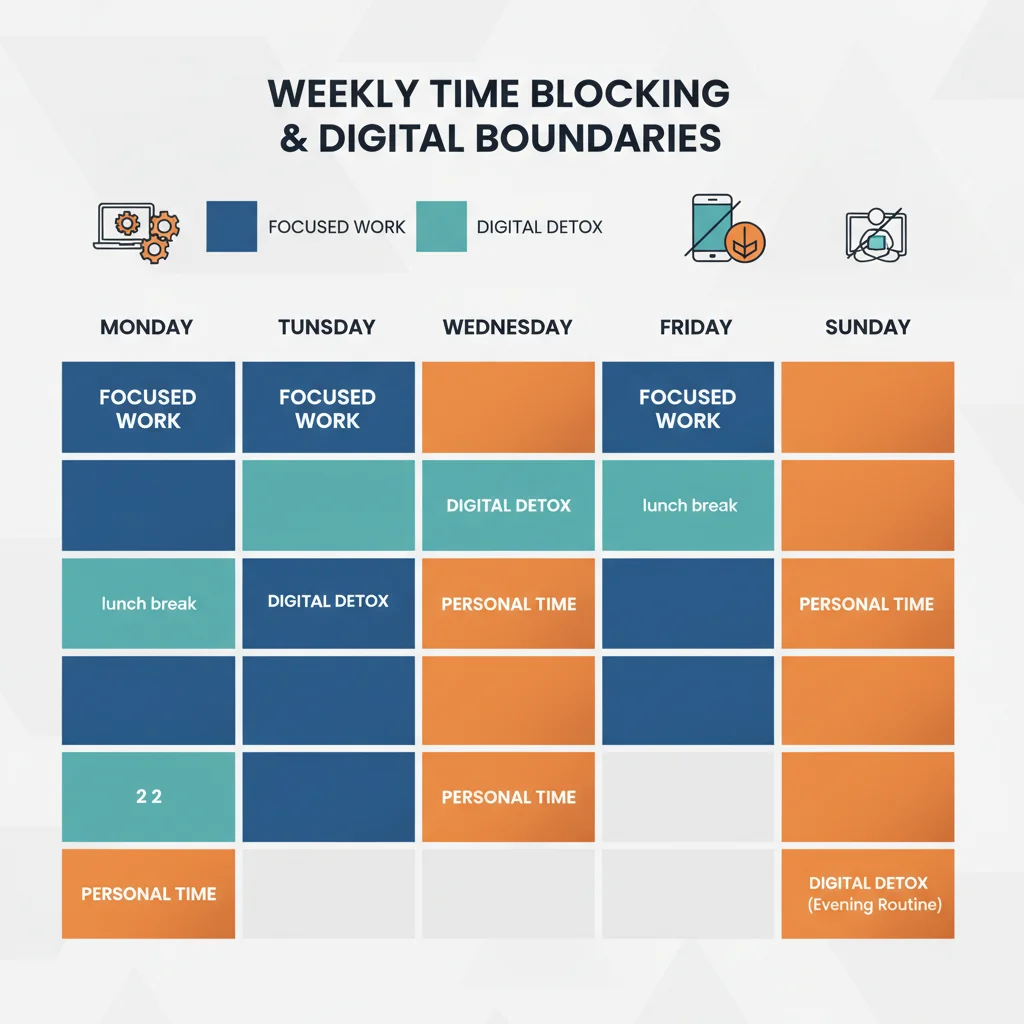
Strategy 2: The ‘Deep Work Block’ & ‘Shallow Work Sprint’ Model
Traditional time management often falls short in the face of digital distractions. The ‘Deep Work Block’ and ‘Shallow Work Sprint’ model is one of the most powerful digital well-being strategies for optimizing productivity and reclaiming focus. This strategy is inspired by Cal Newport’s concept of Deep Work, adapted for the hyper-connected environment of 2026.
Deep Work Blocks: Uninterrupted Focus
Deep work is the ability to focus without distraction on a cognitively demanding task. It’s how you produce high-quality output in a shorter amount of time. To implement Deep Work Blocks:
- Schedule Non-Negotiable Blocks: Dedicate 2-4 hour blocks in your calendar specifically for deep work. During these times, all notifications are off, emails are closed, and you are singularly focused on one critical task. Communicate these blocks to colleagues and family to minimize interruptions.
- Choose Your Environment Wisely: Find a quiet space where you won’t be disturbed. This might be a co-working space, a library, a specific room at home, or even a coffee shop with minimal distractions.
- Prepare for Deep Work: Before starting a block, ensure you have everything you need (water, notes, etc.) to avoid breaking your concentration. Close all unnecessary tabs and applications.
Shallow Work Sprints: Efficient Task Management
Shallow work refers to non-cognitively demanding tasks, such as answering emails, scheduling, administrative duties, and quick communication. Instead of letting these tasks interrupt your deep work, batch them into ‘Shallow Work Sprints.’
- Designated Sprint Times: Allocate specific, shorter blocks (e.g., 30-60 minutes) for shallow work. This could be once or twice a day. During these sprints, you tackle all your emails, messages, and administrative tasks efficiently.
- Avoid Context Switching: The goal is to prevent shallow work from infiltrating your deep work blocks. By creating dedicated sprints, you reduce constant context switching, which is a major time and energy drain.
Reclaiming Time Through Focused Work
By segmenting your day into these distinct blocks, you prevent the constant interruption and context switching that plagues modern work. This leads to higher quality output in less time, freeing up hours each week. Imagine accomplishing in 6 hours what used to take 8-10, simply by being more intentional with your digital engagement. This is one of the most effective digital well-being strategies for professional and personal life.
Strategy 3: The ‘Intentional Inbox Zero’ and ‘Notification Audit 2.0’
Email and notifications are notorious time sinks. The ‘Intentional Inbox Zero’ combined with ‘Notification Audit 2.0’ represents a proactive approach to managing these digital demands, making it a cornerstone of effective digital well-being strategies.
Intentional Inbox Zero: More Than Just an Empty Inbox
Inbox Zero isn’t just about having no emails in your inbox; it’s about processing each email mindfully and intentionally. For 2026, we elevate this to ‘Intentional Inbox Zero’ – a system designed to minimize time spent in your email client while maximizing responsiveness.
- Scheduled Email Checks: Instead of constantly checking email, schedule 2-3 specific times per day (e.g., 9 AM, 1 PM, 4 PM) to process your inbox. Outside these times, email applications remain closed.
- The 4 D’s of Email Management: When an email comes in, immediately apply one of these actions:
- Delete: If it’s spam or irrelevant.
- Do: If it takes less than 2 minutes to respond or act on.
- Delegate: If it’s better handled by someone else.
- Defer: If it requires more time, move it to a ‘To Do’ list or schedule a specific time to address it.
- Automate Where Possible: Utilize email rules and filters to automatically sort non-essential emails into specific folders (e.g., newsletters, promotions) that you can review at a designated time, or not at all.
Notification Audit 2.0: The Aggressive Pruning
Notifications are designed to pull your attention away. Notification Audit 2.0 is about an aggressive, systematic review and reduction of all digital pings.
- Default to Off: Assume all notifications should be off unless there’s a compelling, productivity-enhancing reason for them to be on. Most apps do not need to send you push notifications.
- Categorize and Prioritize: For essential notifications (e.g., critical work alerts, family messages), differentiate between ‘urgent’ and ‘important.’ Use different notification settings for each. For example, only allow calls from starred contacts to break through ‘Do Not Disturb’ modes.
- Weekly Review: Dedicate 10-15 minutes each week to review your notification settings across all devices. Apps constantly update and often re-enable notifications by default. Stay vigilant.
- Wearable Tech Integration: If you use smartwatches, configure them to only show truly essential notifications, acting as a secondary filter rather than an additional source of distraction.
The Time-Saving Impact
By mastering your email and notifications, you eliminate countless micro-interruptions that fragment your attention and extend task completion times. This strategy alone can reclaim several hours each week, allowing for more sustained focus and less mental fatigue. It’s a critical component of effective digital well-being strategies.
Strategy 4: The ‘Digital Sabbath’ & ‘Micro-Detox’ Framework
Complete disconnection can feel daunting, but the ‘Digital Sabbath’ and ‘Micro-Detox’ framework offers a flexible yet powerful way to integrate regular periods of digital abstinence into your life. These are essential digital well-being strategies for mental rejuvenation.
The Digital Sabbath: A Weekly Reset
Inspired by the traditional concept of a Sabbath, a Digital Sabbath is a designated period (e.g., 12-24 hours) each week where you completely disconnect from all non-essential digital devices and online activities. This includes smartphones, tablets, computers, social media, and streaming services. The goal is to fully engage with the physical world, real-life interactions, and personal reflection.
- Choose Your Day/Time: Select a consistent block of time, such as Saturday afternoon to Sunday afternoon, or a weekday evening. Consistency helps build the habit.
- Prepare for Disconnection: Inform friends and family of your Digital Sabbath. Handle any urgent online tasks beforehand. Plan alternative activities like reading a physical book, spending time in nature, pursuing a hobby, or engaging in face-to-face conversations.
- Embrace the Void: The initial hours might feel strange or even uncomfortable as you resist the urge to check your devices. Lean into this feeling. It’s a sign that you’re breaking free from digital dependence.
Micro-Detoxes: Daily Refreshers
Micro-detoxes are shorter, more frequent periods of intentional disconnection integrated throughout your day. They serve as mental refreshers and prevent digital fatigue from building up.
- The ‘First Hour’ Rule: Avoid checking your phone or email for the first hour after waking up. Use this time for personal rituals like meditation, exercise, or journaling.
- The ‘Last Hour’ Rule: Similarly, put away all screens at least an hour before bedtime to prepare your mind for sleep.
- Walks Without a Phone: When going for a short walk, leave your phone behind. Experience your surroundings without the lens of a screen.
- Dedicated Focus Breaks: During work, take 5-10 minute breaks away from all screens. Look out a window, stretch, or grab a drink without digital accompaniment.
Cumulative Time Reclaimed
A weekly Digital Sabbath can reclaim a full day of your week, significantly contributing to the 10-hour goal. Micro-detoxes, while seemingly small, add up quickly. Ten minutes here, twenty minutes there, multiplied across a week, can easily accumulate to several more hours of reclaimed time and improved mental clarity. These are vital digital well-being strategies for sustained mental health.
Strategy 5: The ‘Digital Diet’ & ‘Mindful Consumption’ Approach
Beyond simply limiting screen time, the ‘Digital Diet’ and ‘Mindful Consumption’ approach focuses on the quality of your digital interactions. This is about being discerning about what you consume and how it impacts your mental state, making it one of the most sophisticated digital well-being strategies.
The Digital Diet: Pruning Your Feeds and Subscriptions
Just as you’d manage your food intake, apply the same scrutiny to your digital intake. An unhealthy digital diet can lead to anxiety, comparison, and a sense of inadequacy.
- Unfollow, Unsubscribe, Mute: Ruthlessly unfollow social media accounts that don’t uplift, inspire, or educate you. Unsubscribe from newsletters you never read. Mute group chats that are more noise than value.
- Curate Your Information Sources: Be selective about where you get your news and information. Opt for high-quality, reputable sources and limit your consumption to specific times of the day to avoid doomscrolling.
- App Purge: Regularly review the apps on your phone. Delete anything you haven’t used in 30 days or that consistently drains your time and energy without providing real value. The fewer apps, the less temptation.
Mindful Consumption: Engaging with Purpose
When you do engage with digital content, do so mindfully. This means being present and intentional, rather than passively consuming.
- Ask ‘Why?’: Before opening an app or clicking a link, ask yourself: ‘Why am I doing this? What value will I gain?’ If the answer isn’t clear, reconsider.
- Timebox Entertainment: If you enjoy social media or streaming, timebox it. Set a timer for 15-30 minutes and stick to it. Engage with specific content, then close the app.
- Active Learning Over Passive Scrolling: Prioritize digital activities that involve active learning, creation, or meaningful connection over passive scrolling or endless entertainment.
- Use ‘Grayscale’ Mode: Experiment with setting your phone to grayscale. The lack of vibrant colors makes apps less appealing and can reduce addictive tendencies.
The Power of Intentionality
By implementing a Digital Diet and practicing Mindful Consumption, you transform your digital interactions from reactive habits into intentional choices. This not only saves time by reducing aimless browsing but also improves your mental clarity and reduces information overload, directly contributing to your digital well-being strategies and the goal of reclaiming 10 hours weekly.
Integrating These Digital Well-being Strategies into Your Life for 10 Hours Reclaimed
Achieving the goal of reclaiming 10 hours weekly through these digital well-being strategies requires consistency, self-awareness, and a willingness to experiment. It won’t happen overnight, but with persistent effort, the cumulative benefits are profound.
Start Small, Scale Up
Don’t try to implement all five strategies at once. Pick one or two that resonate most with you and start there. Once those habits are established, gradually introduce others. For example, begin with the ‘First Hour’ micro-detox and establishing your bedroom as a Digital Sanctuary. Then move on to scheduling Deep Work Blocks.
Track Your Progress
Use a journal or a simple app to track your screen time and how you’re spending your reclaimed hours. Seeing tangible progress can be incredibly motivating. Note down how you feel when you successfully implement a Digital Sabbath or complete a Deep Work Block. This self-reflection reinforces positive behavior.
Communicate Your Boundaries
For these digital well-being strategies to be effective, it’s crucial to communicate your digital boundaries to friends, family, and colleagues. Let them know when you’ll be unavailable (during Deep Work Blocks or Digital Sabbaths) and how best to reach you for urgent matters. Most people will respect your efforts to improve your well-being.
Be Kind to Yourself
There will be days when you slip up. Don’t let a single lapse derail your entire effort. Acknowledge it, understand what triggered it, and recommit to your strategies the next day. Digital well-being is a journey, not a destination.
The Future of Digital Well-being: Beyond 2026
As technology continues to evolve, so too must our digital well-being strategies. The principles outlined here – intentionality, boundary setting, mindful consumption, and periodic disconnection – will remain timeless. However, the specific applications may need to adapt. Staying informed about new digital tools that promote well-being, participating in communities that value digital balance, and continuously evaluating your own relationship with technology will be key to sustaining a healthy digital life in the years to come.
Imagine a life where technology serves you, rather than the other way around. A life where you have ample time for your passions, your loved ones, and your personal growth. By embracing these five new digital well-being strategies for 2026, you’re not just limiting screen time; you’re actively creating a richer, more fulfilling existence. Reclaiming 10 hours weekly is an ambitious yet entirely achievable goal that promises a profound positive impact on every facet of your life.
Start today. Choose one strategy, commit to it, and experience the transformative power of intentional digital living. Your future, more balanced self will thank you.