AI Adoption: Reshaping US Workforce Demographics by 2026

The landscape of the American workforce is on the cusp of an unprecedented transformation. With a projected 25% increase in Artificial Intelligence (AI) adoption by 2026, the economic footprint of automation is set to profoundly reshape U.S. workforce demographics. This isn’t merely a technological shift; it’s a societal and economic metamorphosis that demands careful consideration, strategic planning, and proactive adaptation. The widespread integration of AI across industries promises efficiencies, innovation, and new opportunities, but it also presents challenges related to job displacement, the demand for new skills, and the imperative to ensure an inclusive and equitable transition for all workers.
Understanding this seismic shift requires delving into multiple facets: the historical context of technological disruption, the specific sectors most vulnerable and those poised for growth, the skills gap that will emerge, and the policy implications necessary to navigate this complex future. The goal is not to resist the inevitable march of progress but to intelligently steer its course, maximizing its benefits while mitigating its potential pitfalls. The impact of AI adoption workforce changes will be felt from the factory floor to the executive suite, demanding a collective effort from individuals, businesses, educational institutions, and government bodies.
The Inevitable Rise of AI: A Historical Perspective on Technological Disruption
Throughout history, technological advancements have consistently reshaped labor markets. From the agricultural revolution to the industrial revolution and the digital age, each epoch brought about significant changes in how work was performed, the types of jobs available, and the skills required. The steam engine, electricity, and the internet all, in their time, sparked fears of widespread unemployment, yet ultimately led to new industries, increased productivity, and a higher standard of living. AI, however, represents a qualitatively different kind of disruption. Unlike previous technologies that primarily automated manual or repetitive tasks, AI is increasingly capable of performing cognitive tasks, learning from data, and even exhibiting a form of creativity. This capacity extends its reach into sectors previously considered immune to automation, including professional services, healthcare, and creative industries.
The current wave of AI adoption is characterized by its accelerating pace and pervasive nature. Machine learning algorithms are becoming more sophisticated, data availability is exploding, and computational power continues to grow exponentially. This confluence of factors means that AI is not just enhancing existing tools but fundamentally altering the nature of work itself. Tasks that once required human judgment, pattern recognition, and complex decision-making are now within the purview of intelligent systems. This doesn’t necessarily mean humans are being replaced entirely; often, AI acts as a powerful co-pilot, augmenting human capabilities and allowing for greater focus on higher-level, strategic, and creative endeavors. However, the sheer scale of the projected 25% increase in AI adoption by 2026 suggests that the aggregate effect on U.S. workforce demographics will be profound and widespread.
Sectoral Impact: Who Wins and Who Loses in the AI Adoption Workforce Era?
The impact of AI adoption will not be uniform across all sectors of the U.S. economy. Some industries are inherently more susceptible to automation, while others are poised to benefit significantly. Understanding these differential impacts is crucial for anticipating workforce shifts and developing targeted strategies.
Manufacturing and Logistics: Continued Automation and Efficiency Gains
Historically, manufacturing has been at the forefront of automation, and AI will only accelerate this trend. Robots equipped with AI can perform more complex assembly tasks, quality control, and predictive maintenance. In logistics, AI-powered algorithms optimize supply chains, manage warehouse inventories, and guide autonomous vehicles. While this will lead to increased efficiency and reduced production costs, it will also likely result in a decline in demand for routine manual labor in these sectors. However, new roles will emerge in robot maintenance, AI system oversight, and data analysis for optimizing automated processes.
Customer Service and Administrative Roles: AI as a First Line of Defense
Customer service, call centers, and many administrative functions are prime candidates for AI augmentation. Chatbots and virtual assistants powered by natural language processing (NLP) can handle a significant volume of routine inquiries, schedule appointments, and provide basic support. This could lead to a reduction in entry-level positions in these areas. Yet, it also frees human agents to focus on more complex, empathetic, and nuanced customer interactions, where emotional intelligence and problem-solving skills are paramount. The AI adoption workforce shift here will be towards roles requiring higher-order communication and critical thinking.
Healthcare: Aiding Diagnosis and Personalized Treatment
AI’s potential in healthcare is revolutionary. From assisting in diagnosing diseases (e.g., analyzing medical images with greater accuracy than humans) to personalizing treatment plans and accelerating drug discovery, AI can significantly improve patient outcomes and operational efficiency. While some administrative tasks in healthcare may be automated, the demand for healthcare professionals, especially those with advanced clinical skills and a human touch, is likely to remain strong or even increase. AI will augment doctors, nurses, and researchers, allowing them to perform their jobs more effectively and spend more time on direct patient care.
Finance and Accounting: Data Analysis and Fraud Detection
In finance, AI is already transforming tasks like algorithmic trading, fraud detection, and risk assessment. AI can process vast amounts of financial data to identify patterns and anomalies far beyond human capacity. This will likely automate many routine data entry, reconciliation, and auditing tasks in accounting. However, it will also create a greater need for financial analysts who can interpret AI-generated insights, develop new financial products, and advise clients on complex financial strategies. The AI adoption workforce in this sector will prioritize analytical and strategic thinking over repetitive data processing.
Creative Industries and Education: Augmentation, Not Replacement
Even traditionally human-centric fields like creative arts and education will experience AI’s influence. AI can generate preliminary designs, compose music, or assist in writing. In education, AI can personalize learning experiences, grade assignments, and provide adaptive tutoring. While AI can be a powerful tool for creativity and learning, the core human elements of artistic expression, critical pedagogy, and empathetic mentorship are unlikely to be fully replaced. Instead, AI will serve as an assistant, enabling creators and educators to be more productive and innovative.
The Emerging Skills Gap: Bridging the Divide
The projected 25% increase in AI adoption by 2026 will inevitably exacerbate the existing skills gap and create new ones. As routine tasks become automated, the demand for uniquely human skills will surge. This requires a significant re-evaluation of educational curricula, corporate training programs, and individual career development strategies.
In-Demand Skills for the AI Era
- Digital Literacy and AI Fluency: A foundational understanding of how AI works, its capabilities, and its limitations will become essential for almost every professional. This doesn’t mean everyone needs to be an AI developer, but rather an informed user and collaborator with AI systems.
- Critical Thinking and Problem-Solving: As AI handles data processing, humans will need to focus on interpreting results, asking the right questions, and solving complex, unstructured problems that require nuanced judgment.
- Creativity and Innovation: AI can generate variations, but true innovation often stems from human imagination, intuition, and the ability to connect disparate ideas. These skills will be highly valued.
- Emotional Intelligence and Interpersonal Skills: Tasks requiring empathy, negotiation, teamwork, and leadership are inherently human. As AI takes over more routine interactions, the demand for human connection and effective collaboration will increase.
- Adaptability and Lifelong Learning: The pace of technological change means that skills acquired today may be obsolete tomorrow. A mindset of continuous learning and adaptability will be paramount for navigating the evolving job market.
- Data Ethics and Governance: With the proliferation of AI, understanding the ethical implications of data use, privacy, and algorithmic bias will become critical for many roles.
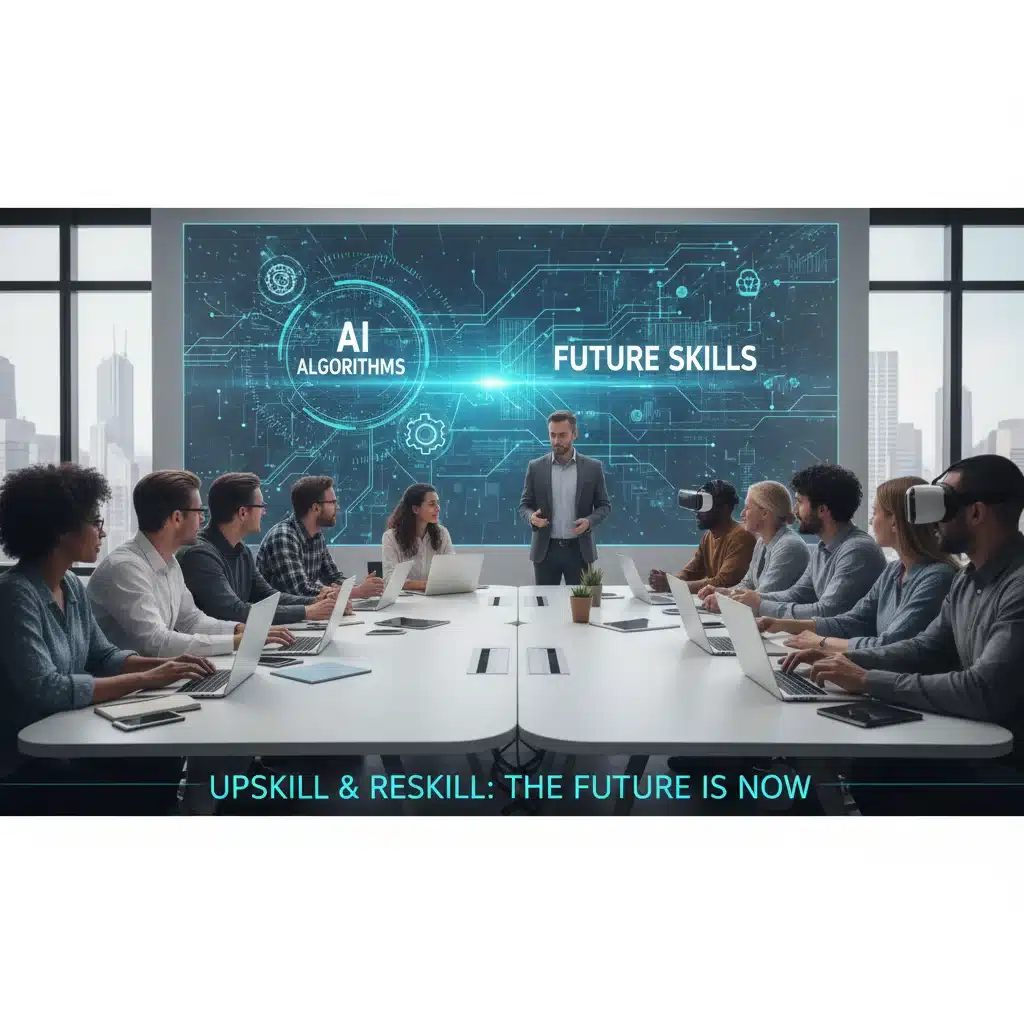
The Imperative of Upskilling and Reskilling
For individuals whose jobs are at risk of automation, upskilling (enhancing existing skills) and reskilling (learning entirely new skills) are not just options but necessities. Governments, educational institutions, and businesses must collaborate to provide accessible, affordable, and relevant training programs. This could involve:
- Apprenticeships and Vocational Training: Bridging the gap between academic learning and practical application, especially in emerging technical fields.
- Online Learning Platforms: Offering flexible and scalable options for acquiring new skills, from coding to data analysis and AI ethics.
- Corporate Training Initiatives: Companies investing in their existing workforce to transition them into new roles that complement AI technologies.
- Public-Private Partnerships: Collaborating to identify future skill needs and develop curricula that meet those demands.
Economic Footprint: Macroeconomic Implications of AI Adoption Workforce Changes
The projected 25% increase in AI adoption by 2026 will have significant macroeconomic consequences for the U.S. economy, influencing productivity, income distribution, and overall economic growth. While the long-term benefits of AI are often touted, the transition period will require careful management to avoid exacerbating existing inequalities.
Productivity Gains and Economic Growth
One of the most widely anticipated benefits of AI is a substantial boost in productivity. By automating repetitive tasks, optimizing processes, and enabling faster decision-making, AI can allow businesses to produce more goods and services with the same or fewer resources. This increased efficiency can translate into higher corporate profits, lower consumer prices, and ultimately, accelerated economic growth. The economic footprint of AI adoption could be a significant driver of prosperity, provided these gains are distributed equitably.
Impact on Wages and Income Inequality
The effect of AI on wages is more complex. For workers whose skills are augmented by AI, or who are in high-demand AI-related fields, wages are likely to increase. However, for those whose jobs are displaced or whose skills become less valuable, wages could stagnate or decline. This could potentially widen the gap between high-skilled and low-skilled workers, exacerbating income inequality. Policies such as universal basic income, wage subsidies, or stronger social safety nets might be considered to mitigate these effects during the transition.
Job Displacement and Creation: A Dynamic Equilibrium
While AI is expected to displace a significant number of jobs, it is also anticipated to create new ones. The challenge lies in the fact that the new jobs may require different skills and be in different sectors or geographical locations than the jobs that are lost. For instance, while manufacturing line workers might be displaced, there will be a growing demand for AI engineers, data scientists, robot technicians, and ethical AI specialists. The net effect on employment levels is a subject of ongoing debate, but the consensus is that the composition of the workforce will change dramatically. The AI adoption workforce will be characterized by flux and the need for continuous adaptation.
Geographical Disparities
The impact of AI may also vary geographically. Regions with a higher concentration of industries susceptible to automation might experience greater job losses, while tech hubs and areas with strong educational institutions capable of fostering new skills might see growth. This could lead to increased regional economic disparities, necessitating targeted regional development strategies and investments in infrastructure and education.
Policy Implications: Navigating the AI Frontier
To effectively manage the profound changes brought about by a 25% increase in AI adoption by 2026, robust and forward-looking policy frameworks are essential. Governments have a critical role to play in ensuring that the economic footprint of AI benefits society as a whole, rather than just a select few.
Investment in Education and Training
Foremost among policy priorities must be a massive investment in education and lifelong learning. This includes:
- Reforming K-12 Education: Integrating computational thinking, coding, and AI literacy from an early age.
- Funding Higher Education and Vocational Training: Ensuring that colleges, universities, and technical schools are equipped to train the next generation of AI developers, data scientists, and technicians, as well as to reskill existing workers.
- Subsidies for Adult Learning: Providing financial incentives and support for workers to pursue upskilling and reskilling programs.
- Development of National Skill Frameworks: Identifying future skill needs and creating standardized pathways for skill acquisition and recognition.
Social Safety Nets and Worker Transition Programs
As AI adoption leads to job displacement, strengthening social safety nets will be crucial. This could involve:
- Expanded Unemployment Benefits: Providing more robust support for displaced workers.
- Wage Insurance: Offering partial wage replacement for workers who take lower-paying jobs after being displaced by automation.
- Universal Basic Income (UBI) Trials: Exploring the feasibility and impact of UBI as a potential long-term solution to widespread job displacement.
- Robust Career Counseling and Job Placement Services: Helping displaced workers identify new career paths and connect with relevant training and employment opportunities.
Ethical AI Development and Regulation
As AI becomes more pervasive, ethical considerations move to the forefront. Policies are needed to address:
- Algorithmic Bias: Regulations to prevent AI systems from perpetuating or amplifying existing societal biases.
- Data Privacy: Stronger regulations to protect personal data used by AI systems.
- Accountability and Transparency: Establishing clear lines of responsibility for AI system decisions and ensuring transparency in how AI models operate.
- Worker Protections: Developing new labor laws that address issues like algorithmic management, worker surveillance, and the rights of platform workers in the gig economy.
Fostering Innovation and Entrepreneurship
While mitigating the negative impacts, policies must also encourage the positive aspects of AI. This includes:
- Research and Development Funding: Investing in foundational AI research and development.
- Support for AI Startups: Creating an environment conducive to the growth of new AI-driven businesses, which will be critical for job creation.
- Intellectual Property Rights: Ensuring a robust framework that encourages innovation while also promoting accessibility and fair competition.

Case Studies and Projections: Real-World Glimpses
While the 25% increase in AI adoption by 2026 is a projection, early indicators and ongoing developments offer valuable insights into its potential real-world impact on the U.S. workforce. Observing these trends allows us to better prepare for the larger wave of transformation.
Manufacturing: The Lights-Out Factory and Human Oversight
Consider the rise of ‘lights-out’ factories, where robots and AI systems can operate autonomously 24/7 with minimal human intervention. While this reduces the need for traditional assembly line workers, it simultaneously creates demand for highly skilled technicians to program, maintain, and troubleshoot these complex systems. A major automotive manufacturer, for instance, might reduce its manual labor force by 10-15% over five years but increase its hiring of robotics engineers and AI specialists by 20-30% in the same period. This illustrates the shift in the AI adoption workforce, rather than outright elimination of jobs.
Retail: Personalized Experiences and Automated Checkout
In retail, AI is being used to analyze purchasing patterns, personalize recommendations, and optimize inventory. Automated checkout systems and robotic inventory management are becoming more common. This could lead to a decrease in cashier and stocker roles. However, it also creates opportunities for roles focused on customer experience design, data analytics for personalized marketing, and technical support for in-store AI systems. The focus shifts from transactional roles to experiential and analytical ones.
Financial Services: The Rise of the ‘Quant’ and AI-Powered Advisors
Many financial institutions are already leveraging AI for high-frequency trading, fraud detection, and even customer service through AI-powered chatbots. This automation reduces the need for back-office processing and some entry-level analyst positions. Conversely, there’s a surge in demand for quantitative analysts (quants) who can build and refine AI models, cybersecurity experts to protect financial AI systems, and financial advisors who can use AI tools to provide more sophisticated and personalized advice to clients. The AI adoption workforce in finance is becoming more specialized and technologically driven.
Healthcare: AI-Assisted Diagnostics and Telemedicine
Hospitals are adopting AI for faster and more accurate analysis of medical images (X-rays, MRIs), predicting disease outbreaks, and managing patient records. This augments the capabilities of radiologists and general practitioners, allowing them to focus on complex cases. Telemedicine, often powered by AI for initial symptom assessment, is also expanding access to care. While some administrative roles may be automated, the core demand for doctors, nurses, and specialists remains high, though their daily tasks will increasingly involve interacting with AI tools. This represents an augmentation of the healthcare AI adoption workforce.
Education: Adaptive Learning Platforms
AI-powered adaptive learning platforms are gaining traction, tailoring educational content to individual student needs and providing instant feedback. This can reduce the need for remedial teachers in some contexts but enhances the role of educators as facilitators, mentors, and curriculum designers who leverage AI tools to create more effective learning environments. The AI adoption workforce in education will see a shift towards more personalized and technology-integrated teaching methods.
These examples highlight a consistent theme: AI often transforms jobs rather than completely eliminating them. The key is to anticipate these transformations and equip the workforce with the skills needed for the new roles that emerge. The economic footprint of AI is not solely about job destruction; it’s about job evolution and creation.
The Human Element: Ensuring an Inclusive Transition
Amidst all the technological advancements and economic projections, it’s crucial not to lose sight of the human element. The transition to an AI-driven economy must be inclusive, ensuring that no significant segment of the population is left behind. This requires a multi-pronged approach that addresses concerns about equity, access, and social justice.
Addressing Displaced Workers
For workers whose jobs are significantly impacted by AI, robust support systems are paramount. This includes not only financial aid but also comprehensive career counseling, mental health support, and programs designed to help them identify and transition into new roles. The psychological impact of job loss can be profound, and society has a responsibility to provide a safety net and pathways to new opportunities.
Promoting Diversity and Inclusion in AI Development
If AI systems are built by a homogenous group, they risk perpetuating biases and failing to serve the diverse needs of the population. Encouraging diversity in AI research, development, and deployment teams is essential to creating equitable and fair AI technologies. This also means ensuring that underrepresented groups have access to AI education and career opportunities, contributing to a more representative AI adoption workforce.
Ensuring Equitable Access to Education and Technology
The benefits of AI, particularly in education and healthcare, must be accessible to all, regardless of socioeconomic status or geographical location. Bridging the digital divide and ensuring equitable access to high-quality education and training programs are fundamental for a just transition. This includes investing in broadband infrastructure in rural areas and providing affordable access to digital learning tools.
The Role of Labor Unions and Worker Advocacy
Labor unions and worker advocacy groups will play an increasingly important role in shaping the AI-driven future of work. They can advocate for fair wages, safe working conditions in automated environments, and worker participation in decisions about AI implementation. Collective bargaining can ensure that the benefits of increased productivity from AI are shared more broadly with the workforce, rather than solely accruing to capital owners. Their voice is critical in defining the parameters of the AI adoption workforce.
Conclusion: Embracing the Future of Work with AI Adoption
The projected 25% increase in AI adoption by 2026 represents a pivotal moment for the U.S. workforce. The economic footprint of automation will undoubtedly reshape demographics, job roles, and the very nature of employment. While the challenges of job displacement and the emerging skills gap are significant, the opportunities for increased productivity, innovation, and the creation of new, more fulfilling roles are equally compelling.
Navigating this transformative era successfully requires a concerted effort from all stakeholders. Individuals must embrace lifelong learning and adaptability. Businesses must invest in their workforce, foster a culture of innovation, and ethically deploy AI. Educational institutions must rapidly evolve their curricula to prepare students for the jobs of tomorrow. And governments must implement forward-thinking policies that support education, strengthen social safety nets, regulate AI ethically, and foster an environment conducive to inclusive growth.
The future of work is not a predetermined outcome but a future we collectively build. By proactively addressing the challenges and strategically harnessing the power of AI, the U.S. can ensure that the rise of artificial intelligence leads to a more prosperous, equitable, and innovative future for its entire workforce. The transformation of the AI adoption workforce is not just about technology; it’s about people and their capacity to adapt, learn, and thrive in an ever-changing world.