Bridging the Rural Digital Divide: US Initiatives & 2026 Goals
Bridging the Rural Digital Divide: US Initiatives Aim to Connect 90% of Rural Households by 2026 (Recent Updates)
The digital age has transformed nearly every aspect of modern life, from education and healthcare to commerce and social interaction. Yet, a significant portion of the United States, particularly its rural areas, remains disconnected or underserved. This persistent gap, known as the rural digital divide, creates profound disparities, limiting economic opportunity and access to essential services for millions of Americans. Recognizing the urgency of this challenge, the U.S. government has launched a series of ambitious initiatives with a clear and bold objective: to ensure that 90% of rural households have access to high-speed internet by 2026. This article delves into the strategies, funding, and recent updates concerning these critical efforts to expand rural broadband access.
The promise of universal internet access is not merely about convenience; it’s about equity. For students in rural communities, reliable internet means access to online learning resources, virtual classrooms, and opportunities that are often taken for granted in urban centers. For small businesses, it means reaching broader markets, utilizing cloud-based tools, and competing effectively in a global economy. In healthcare, telemedicine can revolutionize access to specialists and routine care, reducing travel burdens and improving health outcomes for those in remote areas. Furthermore, modern agriculture increasingly relies on precision farming technologies, which demand robust internet connectivity to optimize yields and manage operations efficiently. The lack of adequate rural broadband access is a fundamental barrier to progress in these and many other sectors.
The target of 90% connectivity by 2026 is not just an arbitrary number; it represents a significant leap forward, aiming to bring the benefits of the digital economy to communities that have historically been left behind. Achieving this goal requires a multi-pronged approach, involving substantial federal investment, innovative technological solutions, and strong partnerships between government, private industry, and local communities. This ambitious undertaking is one of the most significant infrastructure projects of our time, comparable in scope to the rural electrification efforts of the last century.
Understanding the Rural Digital Divide: A Persistent Challenge
Before examining the solutions, it’s crucial to understand the scope and nature of the rural digital divide. While urban areas often boast multiple high-speed internet providers and competitive pricing, many rural regions struggle with limited options, slow speeds, or no service at all. The Federal Communications Commission (FCC) defines high-speed broadband as 25 megabits per second (Mbps) download and 3 Mbps upload (25/3 Mbps). However, even this benchmark is often considered insufficient for modern demands, especially for households with multiple users or those relying on bandwidth-intensive applications like video conferencing or cloud computing. Many advocates argue for a higher standard, such as 100/20 Mbps, as the true measure of adequate broadband.
The reasons for this disparity are multifaceted. The economics of deploying broadband infrastructure in sparsely populated areas are challenging. The cost per subscriber is significantly higher due to longer distances between homes, difficult terrain, and lower population density, which makes it less attractive for private companies to invest without subsidies. This market failure has historically left many rural communities without viable options. Additionally, outdated infrastructure, regulatory hurdles, and a lack of local expertise have further exacerbated the problem.
The COVID-19 pandemic starkly illuminated the consequences of this divide. As schools shifted to remote learning and businesses transitioned to telework, families without reliable internet found themselves at a severe disadvantage. The pandemic underscored that internet access is no longer a luxury but a fundamental necessity for participation in modern society. This realization has galvanized political will and public support for aggressive action to close the gap, making rural broadband access a top national priority.
Key US Initiatives Driving Rural Broadband Access
The U.S. government has mobilized an unprecedented level of funding and resources to tackle the challenge of rural broadband access. Several key programs and initiatives form the backbone of this effort, each designed to address different aspects of the problem.
The Bipartisan Infrastructure Law (BIL) and the BEAD Program
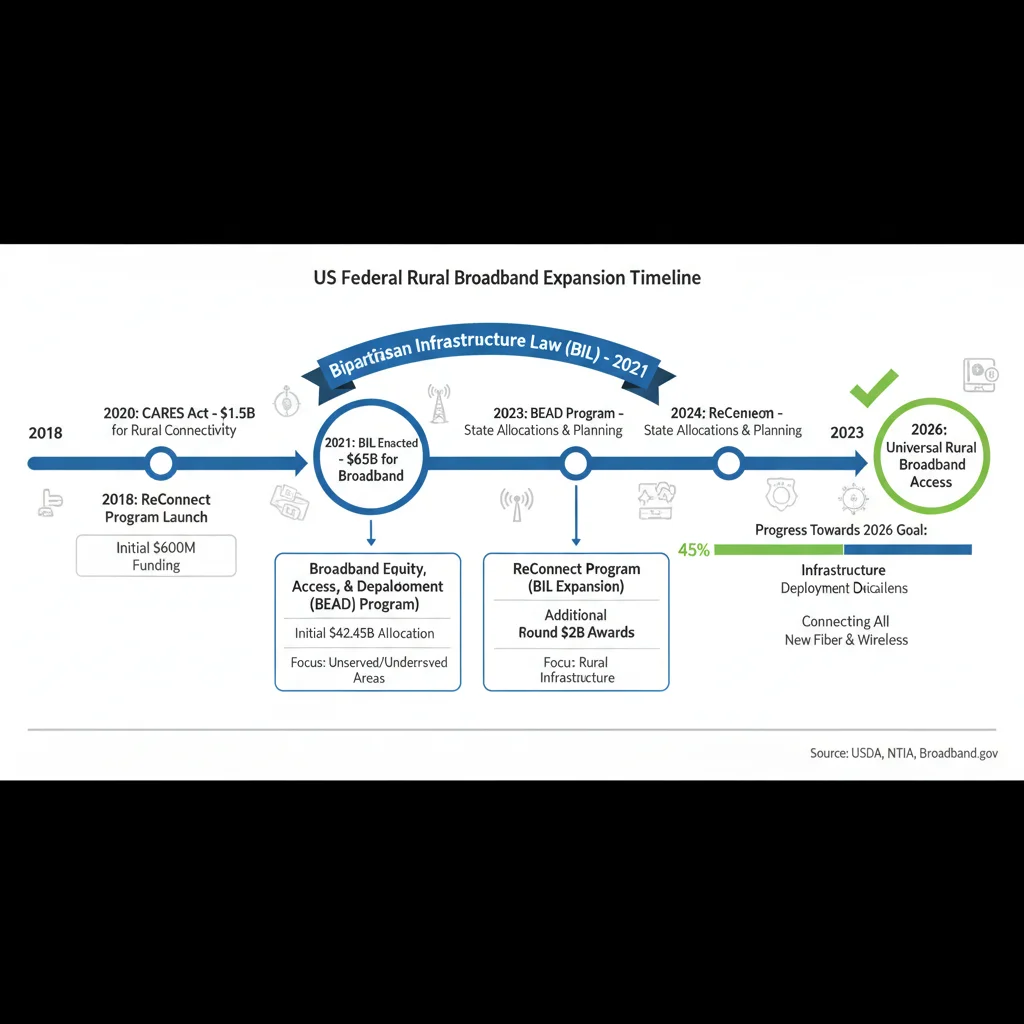
At the forefront of these efforts is the Bipartisan Infrastructure Law (BIL), signed into law in November 2021. This landmark legislation allocates over $65 billion to expand high-speed internet access across the country, with a significant portion specifically targeting underserved and unserved rural areas. The cornerstone of the BIL’s broadband provisions is the Broadband Equity, Access, and Deployment (BEAD) Program, administered by the National Telecommunications and Information Administration (NTIA).
The BEAD Program is a monumental undertaking, providing $42.45 billion to states, territories, and the District of Columbia to deploy and adopt high-speed internet. States are required to use these funds to ensure that all unserved and underserved locations have access to reliable, affordable, high-speed internet service. ‘Unserved’ locations are defined as those lacking access to 25/3 Mbps service, while ‘underserved’ locations lack access to 100/20 Mbps service. This program prioritizes fiber optic deployment, recognizing its long-term reliability and capacity, but also allows for other scalable technologies where fiber is not feasible.
A critical aspect of BEAD is its emphasis on community engagement and digital equity. States must develop comprehensive five-year action plans, including initial proposals that outline how they will identify unserved and underserved locations, engage with local communities, ensure affordability, and promote digital literacy. This holistic approach aims not only to build infrastructure but also to ensure that residents can afford and effectively use the internet services once available. The program also includes provisions for workforce development, ensuring that there are skilled workers to build and maintain the new networks.
USDA’s ReConnect Program
Complementing the BEAD program, the U.S. Department of Agriculture (USDA) continues its vital work through the ReConnect Program. Launched in 2018, ReConnect provides loans, grants, and loan/grant combinations to build broadband infrastructure in rural areas that lack sufficient access. Unlike BEAD, ReConnect specifically focuses on rural areas and has been instrumental in funding projects in some of the most remote parts of the country.
The program has seen multiple funding rounds, with billions of dollars already committed to projects that bring fiber-to-the-home and other advanced technologies to rural communities. ReConnect emphasizes projects that deliver symmetrical speeds of 100 Mbps download and 100 Mbps upload, reflecting a forward-looking approach to internet needs. The USDA’s deep understanding of rural communities and its existing network of relationships make ReConnect a highly effective tool for targeted infrastructure development.
Recent updates to ReConnect have focused on streamlining the application process and increasing outreach to smaller, community-based providers, ensuring that a diverse range of entities can participate in expanding rural broadband access. The program is designed to be technology-neutral where appropriate, allowing applicants to propose the most suitable solutions for their specific geographical and demographic challenges, though fiber is often the preferred technology due to its future-proof nature.
Other Federal Programs and Initiatives
Beyond BEAD and ReConnect, several other federal initiatives contribute to the overall goal:
- Emergency Broadband Benefit (EBB) / Affordable Connectivity Program (ACP): While not directly funding infrastructure, the ACP (which succeeded the EBB) provides discounts on internet service and connected devices for eligible low-income households. This program is crucial for addressing the affordability barrier, ensuring that once infrastructure is built, people can actually use it. Millions of households have already benefited from ACP, underscoring the demand for affordable internet.
- FCC’s Universal Service Fund (USF) Programs: The USF has long supported broadband deployment in high-cost areas through programs like the Connect America Fund (CAF) and the Rural Digital Opportunity Fund (RDOF). While RDOF faced some challenges and clawbacks due to unfulfilled commitments, it demonstrates the ongoing commitment to funding rural buildouts.
- Tribal Broadband Connectivity Program (TBCP): Administered by the NTIA, this program specifically allocates funds to Tribal governments to expand broadband access and adoption on Tribal lands, which are among the most underserved areas in the nation. It addresses the unique challenges and sovereignty considerations of Native American communities.
- State and Local Programs: Many states and local governments are also investing their own funds, often leveraging federal grants, to build out broadband infrastructure. These localized efforts are critical for tailoring solutions to specific community needs and ensuring that federal funds are deployed effectively.
Strategies for Achieving the 90% Goal by 2026
Achieving 90% rural household connectivity by 2026 is an ambitious target that requires a coordinated and innovative approach. The strategies being employed are multi-faceted, addressing not only the physical infrastructure but also the human and economic elements of the digital divide.
Prioritizing Unserved and Underserved Areas
A core strategy is the laser focus on truly unserved and underserved areas. Mapping initiatives, such as the FCC’s new broadband maps, are critical for accurately identifying where service is lacking. These maps, which incorporate granular location data, are designed to be more precise than previous versions, allowing for targeted funding to areas most in need. This data-driven approach minimizes overbuilding in areas that already have service and maximizes the impact of federal dollars. The challenge here is ensuring the accuracy of these maps, as disputes over service availability can significantly impact funding allocations.
Leveraging Diverse Technologies
While fiber optic cable is often considered the gold standard for its speed and reliability, a pragmatic approach recognizes that a single technology won’t solve the problem everywhere. Initiatives encourage the use of a variety of technologies, including:
- Fiber-to-the-Home (FTTH): Preferred for its scalability and future-proofing capabilities, fiber is the primary focus where feasible.
- Fixed Wireless Access (FWA): Often a more cost-effective solution for less dense areas, FWA uses radio signals to deliver broadband over distances. Advances in 5G technology are making FWA a more viable option for high-speed delivery.
- Satellite Internet: For the most remote and challenging terrains, satellite internet remains a crucial option. New low-Earth orbit (LEO) satellite constellations, like Starlink, offer significantly lower latency and higher speeds than traditional geostationary satellites, making them a more competitive choice for rural broadband access.
- Cable and DSL Upgrades: In some areas, existing infrastructure can be upgraded to deliver higher speeds, though this is often a short-term solution compared to fiber.
The key is to select the most appropriate and sustainable technology for each specific geographic and economic context, ensuring that the solutions are both effective and economically viable in the long term.
Promoting Public-Private Partnerships
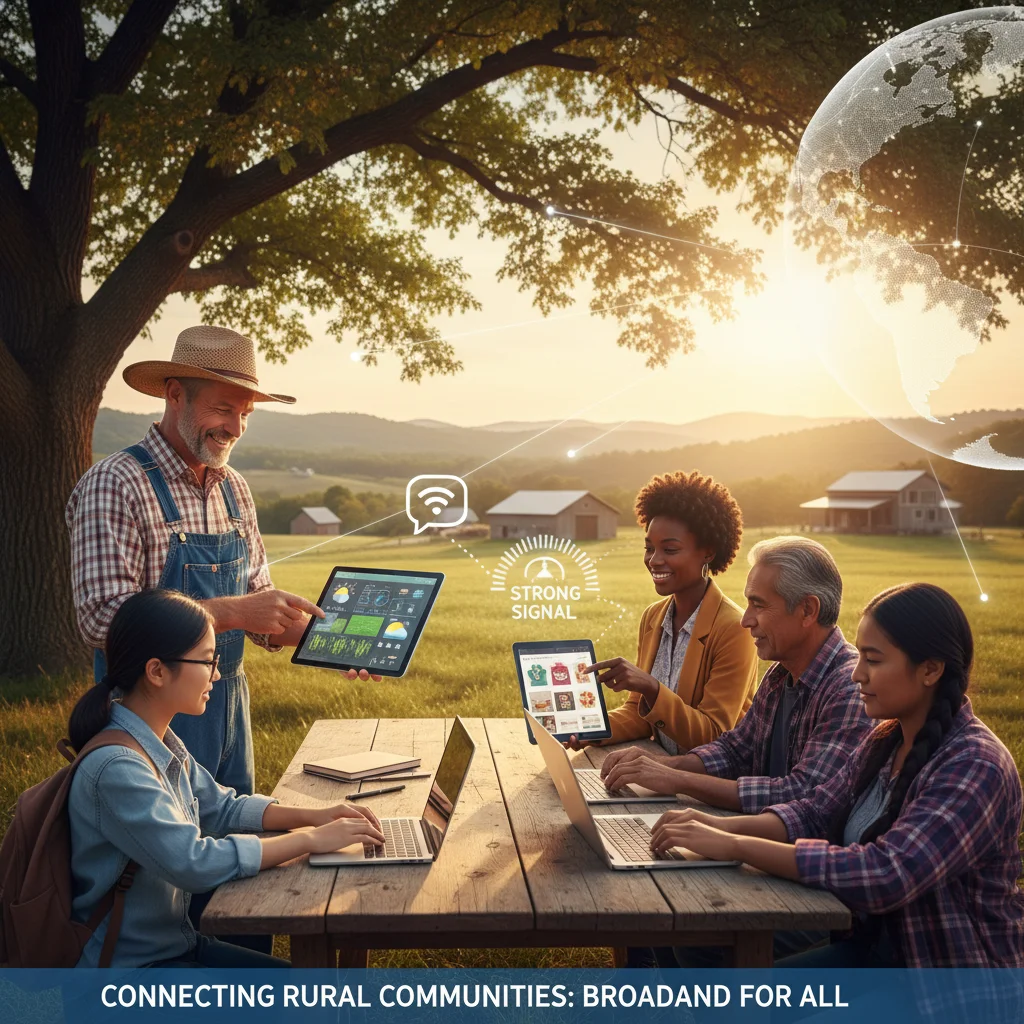
Government funding alone cannot bridge the divide. Strong public-private partnerships are essential. Federal and state programs encourage collaboration between government entities, internet service providers (ISPs), local cooperatives, and community organizations. These partnerships can leverage the private sector’s expertise in network deployment and operations while benefiting from public funding to address the economic challenges of rural buildouts. Many successful projects involve local co-ops or municipal networks, which are often more responsive to local needs and committed to long-term community service.
Addressing Affordability and Digital Literacy
Building the infrastructure is only half the battle. Ensuring that residents can afford and effectively use the internet is equally important. Programs like the Affordable Connectivity Program (ACP) directly address the affordability barrier. Furthermore, digital literacy initiatives are crucial to empower individuals with the skills to navigate the internet safely and productively. These efforts often involve local libraries, community centers, and non-profit organizations providing training and support. Without these complementary efforts, even widespread infrastructure will fail to achieve true digital inclusion.
Recent Updates and Progress Towards 2026
The push for rural broadband access is not static; it’s a dynamic process with continuous updates and adjustments. Recent developments indicate significant momentum:
State Initial Proposals Under BEAD
As of late 2023 and early 2024, states have been submitting their Initial Proposals for the BEAD Program to the NTIA. These proposals are critical blueprints outlining how each state plans to allocate its share of the $42.45 billion. The NTIA is actively reviewing these plans, a process that involves ensuring compliance with federal guidelines, promoting transparency, and soliciting public feedback. Once approved, states can begin the process of awarding grants to ISPs and other entities to start construction. This phase marks a transition from planning to concrete action, with the first substantial BEAD-funded projects expected to break ground in 2024.
Increased ReConnect Funding Rounds
The USDA continues to announce new rounds of funding under the ReConnect Program. These announcements highlight ongoing investments in specific rural communities, bringing high-speed internet to thousands of previously unserved homes and businesses. The program has seen increased demand and has adapted to incorporate lessons learned from earlier rounds, leading to more efficient project selection and deployment.
Evolution of Broadband Mapping
The FCC’s new National Broadband Map has undergone several iterations, incorporating challenges from consumers, providers, and local governments to improve its accuracy. While still imperfect, these maps are vastly more detailed than their predecessors and are essential for guiding funding decisions for BEAD and other programs. Ongoing efforts to refine these maps are critical to ensure that funding is directed to the areas that genuinely need it most, minimizing disputes and maximizing impact.
Technological Advancements and Competition
The telecommunications industry is also evolving rapidly. The expansion of 5G networks, particularly fixed wireless 5G, offers new possibilities for delivering high-speed internet in areas where fiber deployment is challenging. Similarly, the growing number of LEO satellite internet providers is introducing more competition and viable options for the most remote locations. These technological advancements provide more tools in the toolkit for bridging the digital divide, offering flexibility and potentially speeding up deployment in certain contexts.
Challenges and Hurdles to Overcome
While the commitment and resources are substantial, achieving 90% rural household connectivity by 2026 is not without its challenges. Several significant hurdles must be addressed to ensure success:
Workforce Shortages
Building out thousands of miles of fiber optic cable and deploying other infrastructure requires a skilled workforce. There is a recognized shortage of qualified technicians, engineers, and construction workers in the telecommunications industry. Addressing this requires significant investment in training programs, vocational schools, and apprenticeship initiatives. The BEAD program includes provisions for workforce development, but scaling these efforts quickly enough to meet demand will be critical.
Supply Chain Issues
The global supply chain has faced disruptions in recent years, impacting the availability and cost of essential components for broadband deployment, such as fiber optic cable, network equipment, and construction materials. While some of these issues have eased, ongoing geopolitical tensions and increased demand could lead to renewed challenges, potentially delaying projects and increasing costs.
Permitting and Pole Attachments
The process of obtaining permits for construction and attaching new infrastructure to existing utility poles can be time-consuming and complex. Streamlining these processes at federal, state, and local levels is essential to accelerate deployment. Issues related to pole attachment rates and access often create bottlenecks that slow down projects, highlighting the need for continued regulatory reform and cooperation among stakeholders.
Accuracy of Broadband Maps
Despite improvements, the accuracy of broadband maps remains a contentious issue. Inaccurate maps can lead to funding being misdirected or areas being incorrectly deemed as served, leaving truly unserved communities behind. Ongoing challenges and verification processes are vital to ensure that the maps truly reflect the reality on the ground and that all eligible locations receive the necessary support.
Sustaining Affordability and Adoption
Even with infrastructure in place, the long-term sustainability of affordability programs like ACP is crucial. Political will and sustained funding are needed to ensure that low-income households can continue to access and afford internet services. Furthermore, ongoing digital literacy efforts are essential to ensure that all residents, regardless of age or background, can fully participate in the digital world.
The Long-Term Impact of Universal Rural Broadband Access
Achieving the goal of 90% rural household connectivity by 2026 will have a transformative impact on the United States. The benefits extend far beyond simply having internet access; they foster a more equitable, resilient, and prosperous nation.
Economic Growth and Diversification
High-speed internet enables rural businesses to compete globally, attract new industries, and retain young talent. It facilitates e-commerce, cloud computing, and remote work, allowing entrepreneurs to thrive regardless of their physical location. This can lead to job creation, increased local tax revenues, and a more diversified economic base for rural communities, reducing their reliance on traditional industries and making them more resilient to economic downturns.
Improved Education Outcomes
Students in connected rural homes will have equal access to online educational resources, virtual field trips, and advanced learning opportunities. The digital classroom becomes a reality, reducing the achievement gap between urban and rural students. Lifelong learning also becomes more accessible, empowering adults with new skills and career opportunities through online courses and certifications.
Enhanced Healthcare Services
Telemedicine can revolutionize healthcare in rural areas, providing access to specialists, mental health services, and routine care without the need for long-distance travel. Remote monitoring technologies can help manage chronic diseases, improving quality of life and reducing healthcare costs. This is particularly vital for elderly populations and those with limited mobility, ensuring they receive timely and effective medical attention.
Strengthened Community Resilience
In times of crisis, reliable internet access is critical for emergency communications, disaster response, and community coordination. It allows residents to stay informed, access vital resources, and maintain connections with loved ones. Furthermore, it fosters social cohesion by enabling virtual community gatherings, online civic engagement, and access to a broader range of information and services.
Agricultural Innovation
Modern agriculture is increasingly data-driven. From precision farming techniques that optimize irrigation and fertilization to remote monitoring of livestock and crop conditions, high-speed internet is essential for maximizing efficiency and sustainability in farming operations. This can lead to increased yields, reduced waste, and more environmentally friendly practices, benefiting both farmers and consumers.
Conclusion: A Connected Future for Rural America
The U.S. government’s commitment to connecting 90% of rural households by 2026 represents a pivotal moment in the effort to bridge the digital divide. Through massive investments via programs like BEAD and ReConnect, coupled with a focus on diverse technologies, public-private partnerships, and digital equity, the nation is on a path to transform rural America. While significant challenges remain, the coordinated effort and political will are stronger than ever.
The success of these initiatives will not only bring high-speed internet to millions but will also unlock unprecedented opportunities for economic growth, educational advancement, healthcare access, and overall quality of life in rural communities. The vision of a fully connected America, where location no longer dictates access to digital opportunity, is within reach. The coming years will be crucial in demonstrating the effectiveness of these programs and solidifying the foundation for a truly inclusive digital future for all Americans.
The journey to universal rural broadband access is a marathon, not a sprint, but with the current momentum and strategic investments, the finish line of 90% connectivity by 2026 appears increasingly attainable. The long-term dividends for these communities, and for the nation as a whole, will be immeasurable.