US Export Impact 2026: Analyzing New Trade Agreements & Financial Shifts

The global economic landscape is in a constant state of flux, with geopolitical shifts, technological advancements, and evolving domestic priorities continually reshaping international commerce. As we look towards 2026, the United States stands at a crucial juncture, poised to experience significant transformations in its export sector due to a confluence of new trade agreements and policy adjustments. Understanding these impending changes is not merely an academic exercise; it is an imperative for businesses, policymakers, and economists alike seeking to navigate the complex currents of the global marketplace. The US Export Impact in 2026 is projected to be substantial, with some analyses suggesting shifts that could alter export volumes by as much as 8% in certain key sectors, profoundly affecting revenue streams, employment, and the overall economic health of the nation.
This comprehensive analysis delves into the multifaceted aspects of these anticipated shifts, providing an in-depth examination of the forces at play. We will explore the specific trade agreements that are either on the horizon or nearing ratification, dissecting their clauses and potential ramifications. Furthermore, we will consider the domestic policy shifts within the U.S. that are designed to either bolster or reshape export capabilities, such as incentives for specific industries or new regulatory frameworks. The financial implications for various sectors – from agriculture and manufacturing to technology and services – will be a central theme, offering insights into which industries might thrive and which might face headwinds. By understanding these dynamics, stakeholders can better prepare, adapt, and even capitalize on the evolving international trade environment.
The Evolving Landscape of Global Trade Agreements
The bedrock of international commerce lies in the intricate web of trade agreements that dictate tariffs, quotas, intellectual property rights, and regulatory standards. As we approach 2026, several significant multilateral and bilateral trade agreements are either under negotiation, awaiting ratification, or have recently come into force, each carrying the potential to redefine the US Export Impact. These agreements are not merely about reducing barriers; they often reflect broader geopolitical strategies, environmental concerns, and labor standards, making their interpretation and implementation highly complex.
Key Multilateral and Bilateral Agreements on the Horizon
One of the most consequential developments is the ongoing evolution of the World Trade Organization (WTO) framework, despite its current challenges. While large-scale, comprehensive WTO rounds have become increasingly difficult to conclude, smaller, plurilateral agreements on specific issues like e-commerce, investment facilitation, and services domestic regulation continue to progress. These agreements, even if not universally adopted, can set precedents and create new norms that impact how U.S. companies conduct business globally. For instance, an agreement on e-commerce could significantly streamline digital trade, benefiting U.S. tech and service exports by reducing digital protectionism and harmonizing data flow regulations.
Beyond the WTO, regional agreements are gaining prominence. The Comprehensive and Progressive Agreement for Trans-Pacific Partnership (CPTPP), though the U.S. withdrew from its predecessor, remains a significant force in the Asia-Pacific. While direct U.S. participation is not currently on the table, its existence influences supply chains and market access in a region critical for U.S. exports. Future engagements with member countries, even if not through direct accession, will need to consider CPTPP rules.
Bilateral trade agreements, often seen as more agile and tailored, are also a focus. The U.S. has historically pursued these to secure preferential access for its goods and services. Discussions around new bilateral agreements, particularly with fast-growing economies in Southeast Asia, Africa, and Latin America, could open up substantial new markets for U.S. exporters. These agreements typically aim to reduce tariffs, eliminate non-tariff barriers, and establish dispute resolution mechanisms, all of which directly enhance the competitiveness of U.S. products abroad. However, they also often come with demands for reciprocity, potentially increasing competition in the U.S. domestic market for certain goods.
The Role of Geo-Economic Blocs and Strategic Alliances
The global trade landscape is increasingly characterized by the formation and strengthening of geo-economic blocs. The European Union (EU) continues to expand its network of free trade agreements, and its regulatory power often sets global standards, impacting U.S. exporters even without a direct U.S.-EU FTA. Similarly, China’s Belt and Road Initiative and its own network of trade agreements are reshaping trade flows and infrastructure, particularly in developing economies. The U.S. response to these developments, often through initiatives like the Indo-Pacific Economic Framework for Prosperity (IPEF), aims to counter competitive pressures and establish alternative, resilient supply chains that align with U.S. values and economic interests. These strategic alliances, while not always traditional trade agreements with tariff reductions, focus on areas like supply chain resilience, clean energy, and digital trade, which can indirectly but powerfully influence the US Export Impact by creating new markets or diversifying existing ones.
Moreover, the concept of ‘friend-shoring’ or ‘ally-shoring’ – directing supply chains towards politically aligned nations – is gaining traction. This policy, driven by national security concerns and a desire to reduce dependence on geopolitical rivals, could lead to a reconfiguration of global manufacturing and trade routes. While potentially increasing costs in the short term, it aims to foster greater resilience and security for critical goods, which could translate into new export opportunities for U.S. manufacturers in allied countries.
Impact on Specific Sectors: A Preliminary Outlook
The influence of these agreements is rarely uniform across all sectors. Agriculture, for instance, is highly sensitive to tariff reductions and sanitary and phytosanitary (SPS) measures. New agreements could open up new markets for U.S. agricultural products, but also expose domestic farmers to increased competition. The manufacturing sector, particularly advanced manufacturing and high-tech industries, stands to benefit from agreements that protect intellectual property, harmonize technical standards, and facilitate cross-border data flows. Services, an increasingly dominant component of the U.S. economy, could see significant gains from agreements that reduce barriers to cross-border service provision, professional licensing, and digital trade. Conversely, sectors heavily reliant on specific, geographically concentrated supply chains might face disruptions or the need for costly reconfigurations as trade policies shift towards resilience and diversification.
Understanding the nuances of these agreements and their sector-specific implications is crucial for businesses to strategically position themselves for the opportunities and challenges that 2026 will bring to the US Export Impact.
Domestic Policy Shifts and Their Export Implications
While international agreements set the external parameters for trade, domestic policies within the United States play an equally critical role in shaping the nation’s export capabilities and competitiveness. As 2026 approaches, a range of U.S. internal policy adjustments are anticipated, designed to either bolster specific industries, address environmental concerns, or enhance overall economic resilience. These policies, spanning areas from industrial strategy to infrastructure investment, will inevitably influence the overall US Export Impact.
Industrial Policy and Strategic Investments
A notable trend in U.S. domestic policy is the resurgence of industrial policy, aimed at strengthening key strategic sectors. Initiatives like the CHIPS and Science Act, which provides significant funding for domestic semiconductor manufacturing and research, are designed to reduce reliance on foreign supply chains and foster U.S. leadership in critical technologies. While primarily focused on domestic production, the long-term goal is to create a robust ecosystem that can not only meet domestic demand but also generate a surplus for export, particularly of high-value, advanced technological products. Similar investments in renewable energy, biotechnology, and advanced materials could position the U.S. as a global leader in these emerging industries, thereby creating new export niches and increasing the overall volume of U.S. high-tech exports.
However, such policies also carry potential risks. Over-reliance on domestic production without considering global market dynamics could lead to inefficiencies or retaliatory measures from trading partners. The challenge lies in balancing domestic industrial growth with maintaining an open and competitive international trade environment that supports a positive US Export Impact.
Environmental Regulations and Green Exports
The increasing focus on climate change and environmental sustainability is driving significant policy changes within the U.S. New regulations, incentives for green technologies, and carbon pricing mechanisms could have a dual effect on exports. On one hand, stricter environmental standards might increase production costs for some U.S. industries, potentially reducing their international competitiveness. On the other hand, the U.S. is investing heavily in renewable energy technologies, electric vehicles, and sustainable agricultural practices. These investments could position the U.S. as a leading exporter of green technologies, environmental services, and sustainable products. As global demand for environmentally friendly solutions grows, U.S. companies that innovate in these areas could find significant new markets, contributing positively to the US Export Impact. Policies that support the development and export of these ‘green goods’ and services will be crucial.
Labor Standards and Trade Competitiveness
U.S. trade policy has increasingly incorporated provisions related to labor standards, both in domestic legislation and international agreements. The enforcement of fair labor practices, the protection of workers’ rights, and the prevention of forced labor are becoming more prominent considerations. While these policies align with U.S. values, they can also influence export competitiveness. Companies that adhere to high labor standards might face higher production costs compared to those in countries with less stringent regulations. However, for consumers and governments globally who prioritize ethical sourcing and responsible production, U.S. products meeting these standards could gain a competitive edge, particularly in developed markets. Furthermore, policies that invest in workforce development and education can enhance the skills base of U.S. workers, leading to higher productivity and innovation, which indirectly boosts export potential.
Infrastructure Investment and Logistics Efficiency
Robust infrastructure is the backbone of efficient trade. Significant investments in U.S. infrastructure – including ports, roads, railways, and digital networks – are underway or planned. Improved port efficiency, modernized logistics networks, and enhanced digital connectivity can dramatically reduce the time and cost associated with exporting goods. For example, faster turnaround times at ports mean U.S. products can reach international markets more quickly and reliably, making them more attractive to foreign buyers. Digital infrastructure improvements facilitate e-commerce and the export of digital services, which are growing rapidly. These improvements in logistical efficiency directly contribute to the competitiveness of U.S. exports and can help unlock new markets by making it easier and cheaper for businesses to engage in international trade.
In summary, domestic policy shifts in the U.S. are not merely internal affairs; they are powerful determinants of the nation’s ability to compete and thrive in the global export arena. Strategic investments, environmental initiatives, labor policies, and infrastructure upgrades collectively shape the environment in which U.S. exporters operate, directly influencing the US Export Impact in 2026 and beyond.
Financial Implications and Sectoral Analysis
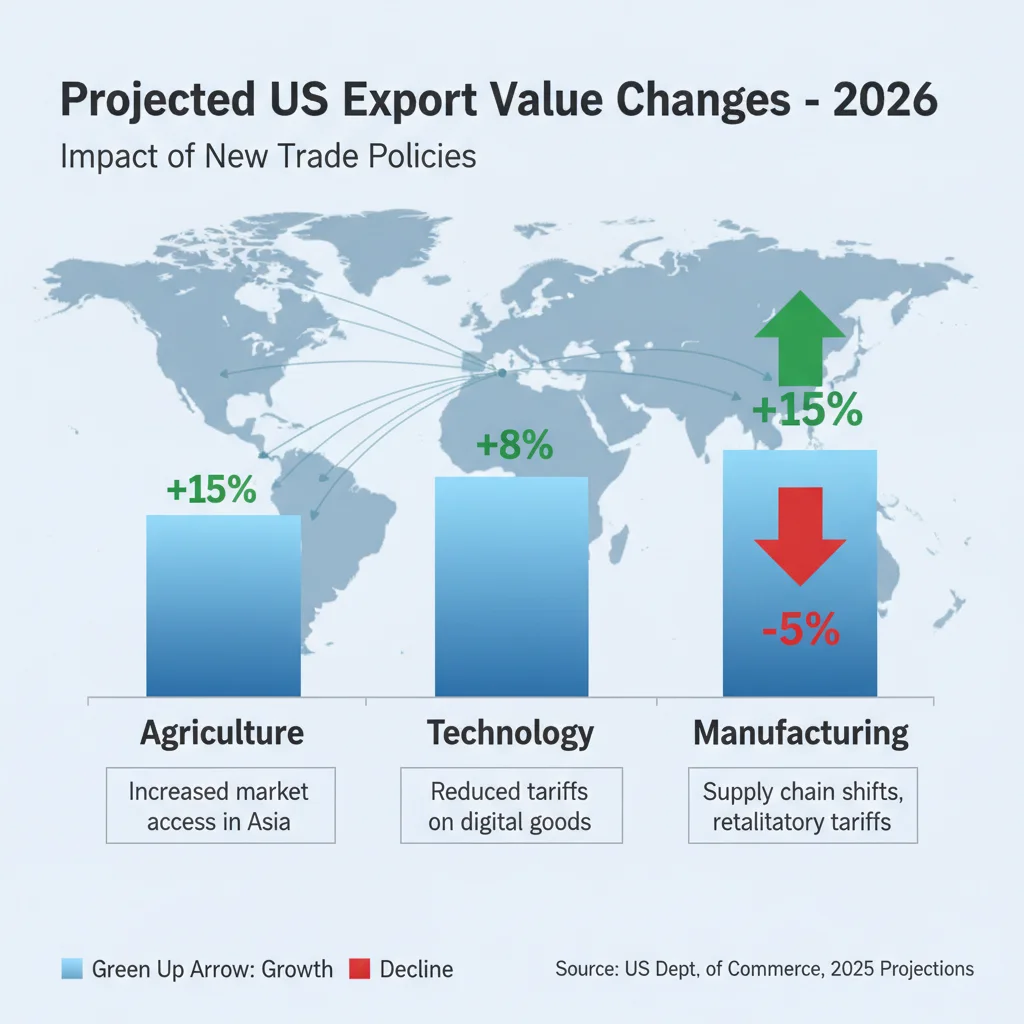
The projected 8% shift in US exports by 2026, driven by new trade agreements and domestic policy changes, represents a significant financial event. This change is not uniformly distributed; instead, it will create winners and losers across various sectors, necessitating a granular analysis of its financial implications. Understanding these dynamics is crucial for investors, businesses, and policymakers to mitigate risks and capitalize on emerging opportunities related to the US Export Impact.
Agriculture: Navigating Subsidies and Market Access
The agricultural sector is one of the most sensitive to trade policy shifts. New agreements can open up lucrative markets for U.S. produce, grains, and meat through tariff reductions and the harmonization of sanitary and phytosanitary standards. For example, a new agreement with a large Asian market could significantly boost soybean or beef exports. Conversely, increased competition from imports due to reciprocal tariff reductions could put pressure on domestic prices for certain commodities. Furthermore, domestic agricultural subsidies, while designed to support farmers, can sometimes be viewed as market-distorting by trading partners, potentially complicating negotiations for new agreements. The financial impact here will be highly dependent on the specific commodities affected and the depth of market access gained versus the competitive pressures faced.
Manufacturing: High-Tech vs. Traditional Industries
The manufacturing sector will experience a bifurcated impact. High-tech manufacturing, including semiconductors, aerospace components, and specialized machinery, stands to benefit significantly from agreements that protect intellectual property, reduce technical barriers to trade, and facilitate cross-border supply chains. U.S. investments in domestic high-tech manufacturing, coupled with strategic trade agreements, could lead to a surge in exports of advanced goods. This could mean increased revenue for companies, job creation in skilled positions, and enhanced global market share. However, traditional manufacturing sectors, particularly those with higher labor costs or less differentiated products, might face increased competition from imports if tariff barriers are lowered without corresponding gains in export markets. The financial health of these sectors will hinge on their ability to innovate, automate, and find niche markets where U.S. quality and reliability are highly valued.
Services Sector: Digital Trade and Professional Services
The U.S. services sector, a powerhouse of the American economy, is poised for substantial growth in its export potential. Agreements that address digital trade, cross-border data flows, and the recognition of professional qualifications can unlock immense opportunities for U.S. software companies, cloud service providers, financial institutions, and consulting firms. The demand for digital services, in particular, is exploding globally, and policies that facilitate their seamless export will directly translate into increased revenues and job growth. However, regulatory fragmentation across countries, particularly concerning data privacy and localization requirements, remains a challenge. The financial success of U.S. service exporters will depend on the extent to which new agreements can harmonize these regulations and create a more predictable operating environment.
Energy Exports: Geopolitical Dynamics and Green Transition
The U.S. has emerged as a significant energy exporter, particularly of crude oil and liquefied natural gas (LNG). Trade policies can influence the flow and pricing of these exports, especially in the context of global energy security and geopolitical tensions. While traditional energy exports might see continued demand, the global push towards decarbonization and the U.S.’s own green energy initiatives will also create new export opportunities for renewable energy technologies, carbon capture solutions, and related services. The financial outlook for the energy sector will involve a delicate balance between maximizing traditional energy exports while strategically investing in and promoting green energy exports, aligning with global climate goals and domestic policy priorities. This dual approach will be critical for a sustained positive US Export Impact in the energy sector.
Supply Chain Resilience and Investment Flows
Beyond direct export volumes, trade policy shifts will also impact global supply chains and foreign direct investment (FDI) flows. Policies promoting ‘friend-shoring’ or ‘near-shoring’ could lead to a reallocation of manufacturing and sourcing, benefiting U.S. companies that invest in allied nations or attract investment from them. This could reshape investment patterns, with capital flowing into sectors and regions deemed strategically important. Companies will need to assess the financial viability of adjusting their supply chain strategies, weighing the costs of reconfiguration against the benefits of increased resilience and reduced geopolitical risk. The ability to adapt quickly to these supply chain shifts will be a key determinant of financial success for many export-oriented businesses.
In essence, the financial implications of the anticipated 8% shift in US Export Impact by 2026 are complex and varied. While some sectors are poised for growth, others will face significant challenges. Proactive planning, strategic investment, and a keen understanding of both international trade agreements and domestic policy shifts will be paramount for businesses to thrive in this evolving landscape.
Navigating the New Trade Environment: Strategies for US Exporters
The projected shifts in the US Export Impact by 2026, driven by new trade agreements and evolving domestic policies, demand a proactive and adaptable approach from U.S. exporters. Navigating this dynamic environment successfully requires strategic planning, diversification, and a deep understanding of market trends. Businesses that anticipate these changes and adjust their strategies accordingly will be best positioned to capitalize on opportunities and mitigate potential risks.
Diversifying Markets and Supply Chains
One of the most crucial strategies for U.S. exporters is market diversification. Over-reliance on a single or a few export markets can expose businesses to significant risks if trade policies or economic conditions in those markets suddenly change. Exploring new and emerging markets, particularly in regions that may benefit from new U.S. bilateral trade agreements or strategic partnerships, can spread risk and open up new revenue streams. This might involve conducting thorough market research, understanding local consumer preferences, and building relationships with new distributors or partners. Similarly, diversifying supply chains is paramount. The lessons learned from recent global disruptions underscore the importance of not having all critical components or raw materials sourced from a single region. ‘Friend-shoring’ and ‘near-shoring’ initiatives, while potentially increasing initial costs, can enhance resilience and reduce geopolitical vulnerabilities, ensuring a more stable flow of goods for export.
Adapting to New Regulatory Frameworks and Standards
New trade agreements often come with updated regulatory frameworks, standards for product safety, environmental compliance, and intellectual property protection. U.S. exporters must stay abreast of these changes and ensure their products and processes comply with the latest requirements in their target markets. This could involve investing in new certifications, re-engineering products, or updating operational procedures. For sectors like agriculture and food, understanding new sanitary and phytosanitary (SPS) measures is critical. For technology and services, adapting to evolving data privacy laws and digital trade regulations will be key. Proactive engagement with trade associations and government agencies can provide valuable insights and support in navigating these complex regulatory landscapes.
Leveraging Technology and Digitalization for Export Growth
Technology will continue to be a powerful enabler of export growth. E-commerce platforms, digital marketing tools, and advanced logistics software can help U.S. businesses, especially small and medium-sized enterprises (SMEs), reach global customers more efficiently and cost-effectively. Investing in digital transformation can streamline export operations, from order processing and inventory management to customs declarations and international shipping. Furthermore, the export of digital services itself is a rapidly expanding area. Companies offering software, IT consulting, online education, and creative services can leverage digital platforms to serve international clients without the traditional logistical hurdles associated with physical goods. Policies that support digital trade and reduce barriers to cross-border data flows will directly benefit these exporters.
Focusing on Value-Added and Differentiated Products
In an increasingly competitive global marketplace, U.S. exporters can differentiate themselves by focusing on value-added products and services. Rather than competing solely on price, emphasizing quality, innovation, brand reputation, and superior customer service can create a competitive advantage. This is particularly true for high-tech manufacturing, specialized agricultural products, and premium consumer goods. Investing in research and development, fostering innovation, and protecting intellectual property are crucial steps in developing these differentiated offerings. Highlighting ethical sourcing, sustainability practices, and adherence to high labor standards can also resonate with environmentally and socially conscious consumers globally, further enhancing the appeal of U.S. exports.
Engaging with Government Support Programs and Trade Promotion Initiatives
The U.S. government offers a variety of programs and resources designed to support exporters, from export financing and insurance to market intelligence and trade promotion missions. Businesses should actively seek out and leverage these resources. Agencies like the U.S. Commercial Service, the Export-Import Bank of the United States (EXIM Bank), and the Small Business Administration (SBA) provide invaluable assistance in navigating international markets, mitigating financial risks, and connecting with potential buyers. Participating in trade shows, virtual trade missions, and government-led export initiatives can open doors to new markets and provide critical insights into global demand trends. Staying informed about new trade policies and engaging with policymakers can also help shape future trade environments in a way that benefits U.S. exporters.

Conclusion: The Future of US Export Impact in 2026
As we have explored, the year 2026 is poised to be a period of significant transformation for the US Export Impact. The interplay of new international trade agreements, evolving domestic policies, and dynamic geopolitical forces will undoubtedly reshape the landscape for American businesses engaged in global commerce. The projected 8% shift in export volumes, while an aggregate figure, masks the nuanced impacts that will be felt across diverse sectors, creating both considerable opportunities and formidable challenges.
For the agricultural sector, the path forward will involve a delicate balance between securing new market access and managing domestic support structures. Manufacturing, particularly in high-tech and advanced industries, stands to gain from strategic investments and intellectual property protections, while traditional industries may need to innovate to maintain competitiveness. The services sector, especially digital services, is on the cusp of exponential growth, contingent on the establishment of clear and harmonized digital trade rules. Energy exports will navigate the dual pressures of global demand for traditional fuels and the accelerating transition to green energy solutions.
The financial implications for businesses will be profound, requiring a critical assessment of current strategies, supply chain resilience, and investment priorities. Companies that embrace diversification, adapt to new regulatory environments, leverage technological advancements, and focus on value-added products will be better equipped to thrive. Furthermore, active engagement with government support programs and industry associations will be crucial for navigating the complexities of the new trade environment.
Ultimately, the future of the US Export Impact in 2026 is not a predetermined outcome but rather a dynamic trajectory that will be shaped by ongoing negotiations, policy decisions, and the strategic responses of American businesses. While challenges are inevitable, the U.S. possesses inherent strengths in innovation, a highly skilled workforce, and a diverse economic base that, when strategically aligned with proactive trade policies, can ensure continued growth and global competitiveness. The imperative for all stakeholders is to remain vigilant, adaptable, and forward-thinking, transforming potential headwinds into opportunities for sustained prosperity in the global marketplace.